
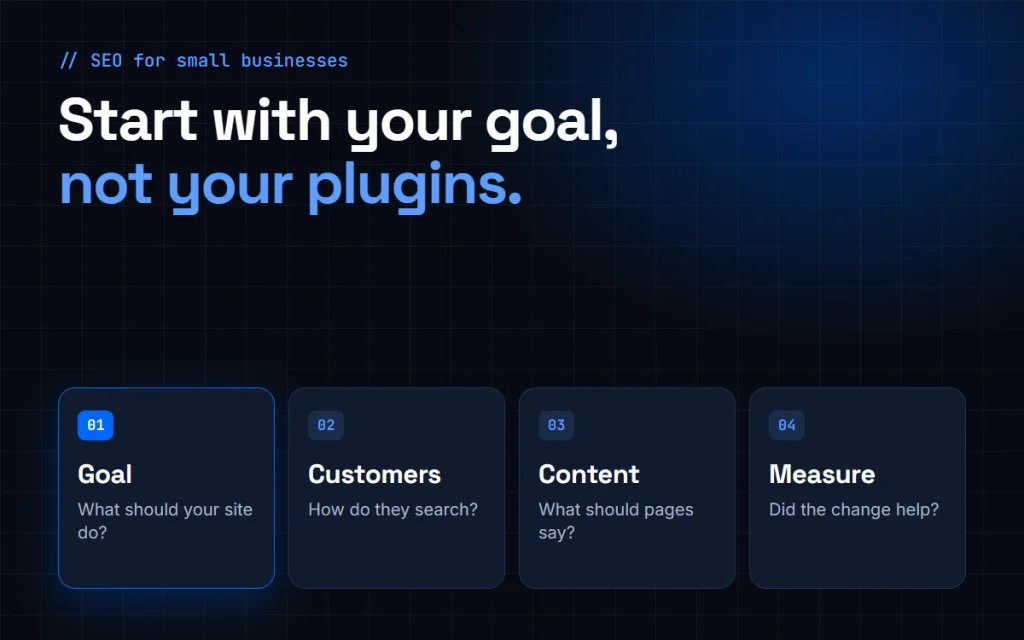
Where should a small business start with SEO? John Mueller and Martin Splitt from Google discuss that question in this episode of Search Off the Record. What I liked most is that their answer doesn’t begin with plugins or technical fixes. It begins with what you want your website to do.
Here are my notes as someone learning SEO. The summary reflects their conversation, and my own view is in the last section.
Start with the Goal of Your Website
Martin describes a food truck whose website doesn’t show the menu, the location or the opening hours. John’s response is to ask what the website is for. If a small restaurant wants people to come in for a meal, it should be as easy as possible to see what it offers, where it is and when it’s open.
Knowing the purpose makes SEO decisions easier. You may find that some things don’t matter for you, and that you’re missing others completely.
Think About Your Customers and How They Search
Before any technical checklist, John suggests working out who your potential customers are and what you want to be found for. Ranking first for something as broad as “restaurant in Zurich” is very hard and probably not useful anyway.
If you need ideas, ask your existing customers how they found you and what they were looking for. Collect those searches, try them yourself and look at what comes up. Then be brutally honest about whether one of your pages could realistically appear there. That shows you what your pages should at least mention.
A Simple Technical Check
There’s no single score that tells you whether your site is technically fine. John’s beginner test is simple: search for your business name and your domain name, and see whether anything shows up. If you’re using a common system like WordPress, Wix or Squarespace, the foundation is probably okay, so you can focus more on content.
Try Things, Then Measure
For most websites, you can simply make a change, leave it for a couple of weeks and see what happens. To do that properly, you need a way to measure:
- Search Console shows the searches people are using to find you.
- Analytics or a real-world measure tracks your actual goal, such as whether people visit your shop after seeing your website.
- Searching for yourself is allowed, and it can quickly show whether a change like a new title has been picked up.
For a homepage and a page or two, John expects changes to show in search within about a week or two. Simple text changes can be picked up fairly quickly, while bigger, more strategic changes can take much longer. John also points out that a staging site can help you check technical things, but it can’t really test how search engines respond to your content.
When to Hire an SEO, and What to Watch Out For
John compares this to hiring a bookkeeper: at some point the work needs doing, and you don’t have the time or don’t want to do it yourself. For SEO, it makes sense once you can see a measurable business result that justifies investing part of that return.
And if you’re happy with the business you have and don’t care about SEO, John says that’s fine too.
If you do hire someone, keep these points in mind:
- Ranking or traffic promises are a red flag. Nobody can go into Google’s systems and put you first for specific terms.
- Expect regular updates. A good SEO should tell you what they did, what’s taking time and when you might expect to see changes.
- Know the rules yourself. Being familiar with Google’s Search Essentials helps you check that the work stays on the right side of the guidelines.
John also says that a site that has never done any SEO will often see a good jump early on, followed by slower, steadier growth.
Do You Still Need to Learn This with AI Around?
John’s answer is yes. Chatbots often base what they say about a business on web content, so a website is part of what makes you visible in those systems. A chat response also can’t replace a store, a subscription or a service. If you want to buy a t-shirt, you want a link to a shop, not instructions for making one.
Where to Learn More
What I’m Taking from This
These are my own thoughts, not advice from Google. If you run a small business and don’t know where to begin, here’s how I’d turn the episode into a starter checklist:
- Write down the one main thing you want visitors to do.
- Make sure your site clearly shows what you offer, where you are and how to reach you.
- Search for your business name and check that your site appears.
- Ask your next few customers how they found you.
- Set up Google Search Console and a way to track your main goal.
- Change one thing, wait a couple of weeks and check what happened.
The red flag about promises also matters to me as a freelancer. I’m still early in my SEO career, and I can’t promise anyone a first-place ranking. What I can do is explain the work, show you what changed and measure the results honestly.
You can watch the full episode on YouTube. If you’d like a second pair of eyes on your website, get in touch.