
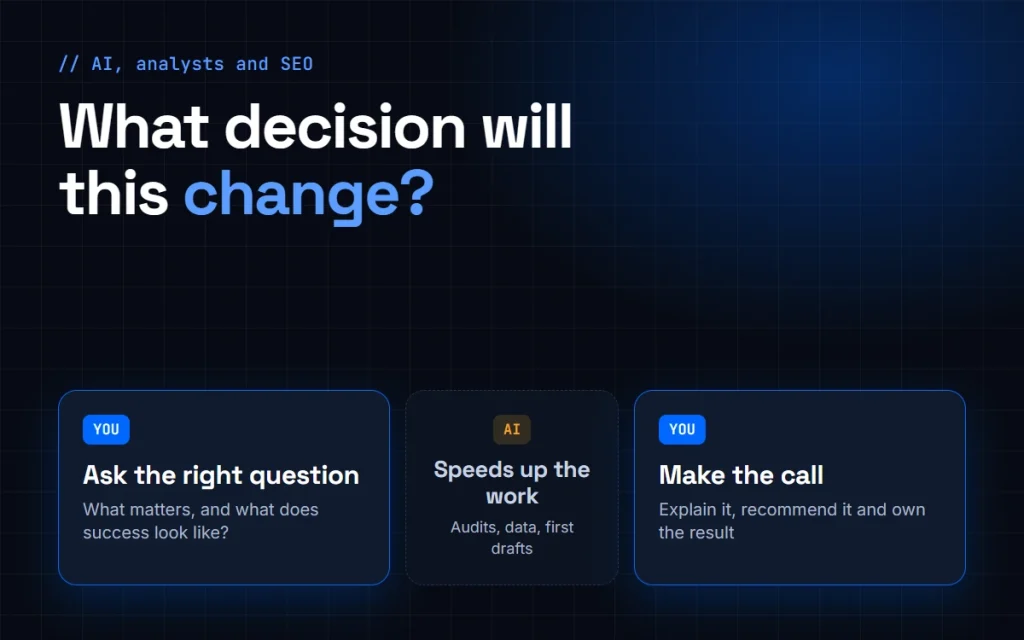
I recently watched a video from Maven Analytics about whether AI is replacing data analysts. Its answer is yes, but mainly the analysts whose whole value was technical execution. It’s about data roles, but as someone moving into SEO, I kept thinking about how closely it applies to my own field.
Here are the main ideas I took from it, and what I think they mean for SEO.
The Question That Changes Everything: “So What?”
The speaker shares a story from early in their career. They were proudly presenting a new monthly report when a senior client interrupted: “Don’t show me the data. Tell me what I should do about it.”
Their point is that a well-built report isn’t worth much if it doesn’t change a decision. They also suggest that an analyst working that way today could be out of a job, because AI tools can now handle much of the building.
AI Is Compressing the Middle of the Work
The video splits analytics work into three parts:
- Planning and framing: working out the business question, the metrics and what success looks like.
- Executing: queries, data cleaning, charts and first-draft analysis.
- Communicating and driving action: explaining what the findings mean and recommending a decision.
AI is speeding up the middle part, so being good at execution alone is less rare than it used to be. The two ends still depend on people. AI doesn’t automatically know what your stakeholders care about most, it can’t earn a skeptical person’s trust, and it can’t be held accountable for a bad call.
Why Demand May Grow, Not Shrink
The video’s more optimistic argument is that cheaper analysis leads companies to ask more questions of their data, not fewer. It cites the World Economic Forum’s Future of Jobs report, which it says ranks analytical thinking as the top skill employers want. It also warns that AI can’t fix a weak data foundation. Without good data, you can simply make bad decisions faster.
The Skills Worth Building
The speaker describes two layers of skills:
- Foundation: data literacy and AI fluency, meaning you can tell whether numbers make sense and you know how to use AI tools well.
- Multipliers: critical thinking, business acumen, judgment, trust and influence, which decide how much value the foundation actually produces.
What This Means for SEO
This part is my own take, not the video’s. SEO work has the same three parts, and I’ve seen the middle one speed up firsthand. When I used Claude to work on my own website, it handled audits, repetitive fixes and retesting quickly. I still had to decide what mattered, review the changes and approve what went live.
Here’s how I’d apply the “so what?” question to common SEO tasks:
- Technical audit: don’t just hand over a long list of issues. Say which few fixes are likely to matter most, and why.
- Keyword research: don’t stop at search volume. Ask which searches could actually bring in customers for this business.
- Ranking report: don’t only show what moved. Explain what it means for traffic and leads, and what to do next.
- PageSpeed scores: a higher score is a means, not the goal. My own scores improved, but the useful question is what that changes for visitors and the business.
I’m still early in my SEO career, so I’m not writing this as an expert. But I find it a useful reminder of where to focus. I don’t want to compete with AI on speed. I want to use it for the repetitive work and get better at the parts it can’t own: understanding a business, making good calls and explaining them clearly.
So before starting any SEO task, I’m going to borrow the video’s best question: what decision is this going to change?
If you’d like help working out which SEO fixes matter most for your website, get in touch.