
I recently watched an episode of Search Off the Record, Google’s podcast about how Search works behind the scenes. Martin from the Search team talks with Nikola Todorovic, who has spent about 15 years at Google and leads the SafeSearch team, about how AI fits into Search.
Here’s what stood out to me as someone learning SEO. The summary reflects what was said in the episode, and my own view is in the last section.
AI in Search Isn’t New, but This Is Still a Big Shift
Google was using machine learning in Search long before generative AI became popular. SafeSearch was one of the earlier places, because its image and video systems could run separately and simply pass a signal to the rest of Search. That made them easier to test and fix. Later, transformer-based systems like BERT and MUM improved ranking as added signals.
Even so, Nikola describes the current wave as a real step change. People are finding that Search can handle more complex questions, so their queries are getting longer and more detailed.
How Google Tests Changes to Search
One of the most useful parts of the episode explains how changes get approved. Search has thousands of changes a year, and each one is measured instead of being launched on instinct:
- Engineers build an experimental version of Search.
- They compare it side by side with the live version on random queries.
- Human raters review the differences using Google’s published guidelines.
- Leads make the final decision in a launch review. Even a change with good overall numbers can be sent back if it has a bad pattern of losses.
According to the episode, AI features go through more or less the same process.
What Is Query Fan-Out?
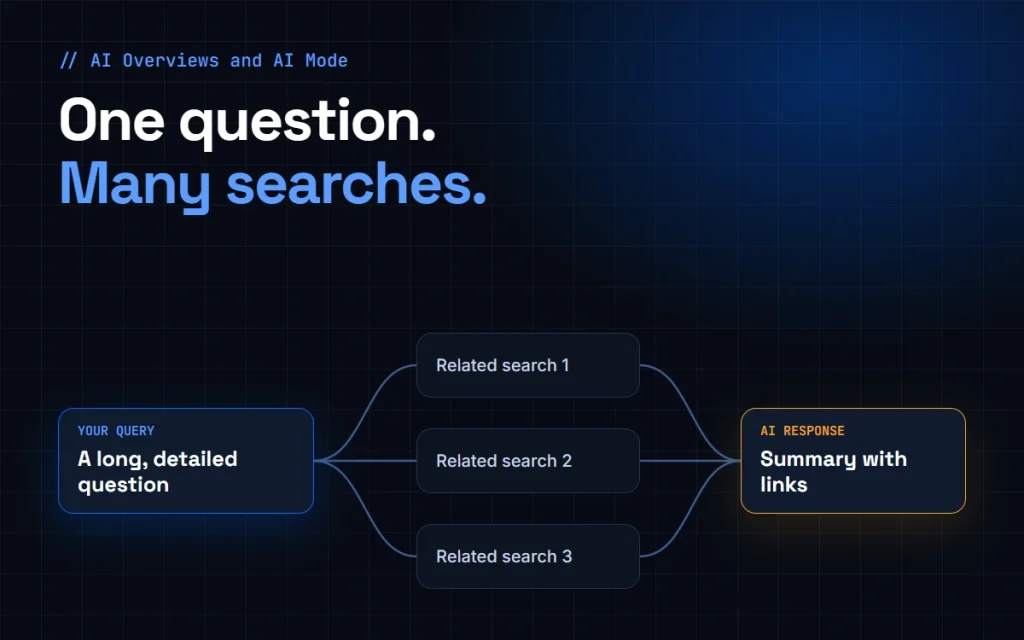
A fan-out is when Search takes your query, identifies related queries that could also help answer it, and retrieves results for all of them in parallel. That helps explain why a long or vague question can still work. Search runs some of the follow-up searches you’d otherwise have to do yourself.
AI Overviews vs. AI Mode
- AI Overviews sit on top of normal Search. Retrieval and ranking work in the established way, possibly with a few fan-outs. The AI then writes a summary from a selection of those results.
- AI Mode is built for longer, multi-turn conversations and has more of its own infrastructure. It still runs on Search, with its own fan-outs, linked results and citations. You can also move into it from an AI Overview when you want to explore further.
What Google’s Advice Means for Site Owners
When the conversation turns to what SEOs should do now, Nikola says there isn’t “a magic wand”. The guidance comes down to two things:
- Keep providing real value to users. People will keep coming back to sites, including through Google, if those sites give them something worthwhile.
- Learn to use AI tools well. Mass-producing cheap content isn’t the recommended approach. Using AI to improve your grammar and style, understand your data or study your competitors is presented as more reasonable.
Martin adds a point I really liked. Chatbots can already turn a spec sheet into readable sentences, so an article that only restates what’s on the box adds little. What AI doesn’t have is your experience of actually using the product and knowing who it suits.
What I’m Taking from This
These are my own conclusions, not Google’s instructions, and I’m still early in my SEO career. Here’s how I plan to apply them:
- Keep working on the basics. AI Overviews and AI Mode still rely on Search, so being crawlable, indexable and relevant still matters. That’s why I still see technical SEO as the starting point for AI search optimization.
- Research the questions around a keyword. Fan-out reminds me that one search can involve several related questions. In keyword research, I want to think about those too. The episode doesn’t say this will get a page cited, but it should make the page more helpful.
- Add what only experience can add. When I wrote about connecting Elementor MCP to Claude, the most useful part was what didn’t work as expected. An AI summary of the feature wouldn’t have told you that.
- Test changes, on a smaller scale. I can’t run experiments the way Google does, but I can record a baseline, make one set of changes and measure again.
The full conversation is worth a listen if you work in SEO: watch the episode on YouTube. And if you’d like help getting your website’s foundations right, get in touch.