
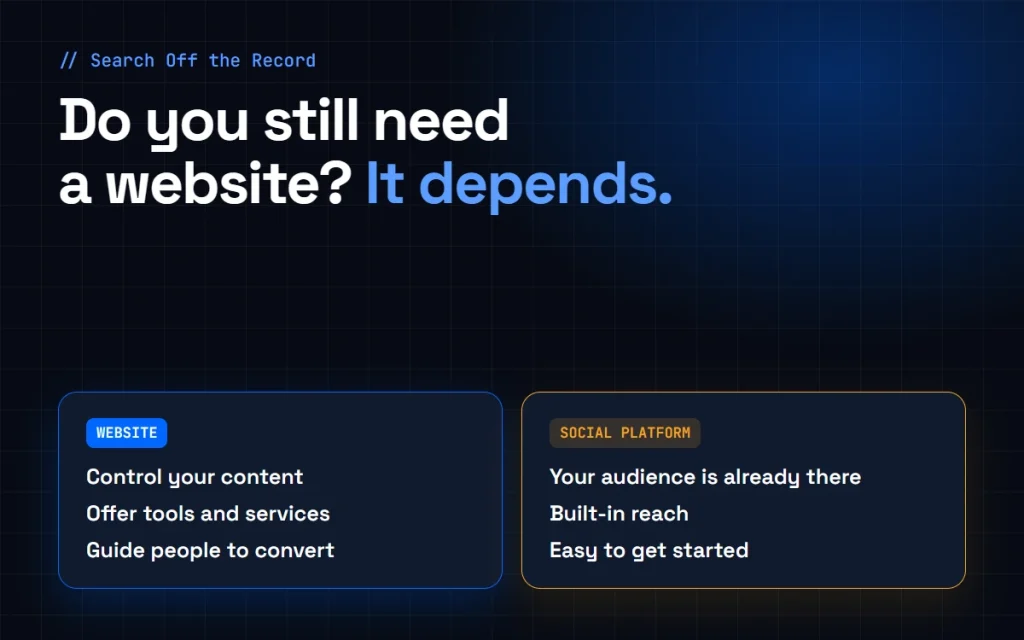
Do you still need a website in 2026? That’s the question Gary and Martin from Google’s Search Relations team discuss in this episode of Search Off the Record. You might expect people from Google Search to say “of course”. Their actual answer is more useful: it depends on what you’re trying to do.
Here are my notes as someone learning SEO. The summary reflects their conversation, and my own view is in the last section.
“The Web Is Dead” Keeps Coming Back
Martin describes this as a claim that returns in waves. First it was apps, then voice assistants, and now chatbots. The difference this time is easy to miss: chatbots still get much of their information from websites. So, for now at least, they see LLMs mostly as another way to reach web content.
They do admit that some things have changed. Fewer people use personal sites to express themselves, and many mobile apps are really websites in a package. Martin also wonders whether knowledge shared in chatbot conversations will flow back to the web or stay locked inside the models.
Where a Website Still Wins
- You make the rules. Within your host’s limits, you decide what you publish and which articles or products get featured. An algorithm doesn’t decide who sees them.
- You control how you earn. You can choose ads, affiliate links or your own offers.
- You can offer real services. Most social platforms can’t host something like a calculator.
- You can publish long-form content. A website gives it a home without depending on a platform’s moderation.
- You can guide people to convert. Gary compares a website to a 24-hour salesperson who can walk someone through a checkout.
- It’s easy for people to try. Clicking a link feels like a much smaller commitment than installing another app.
Martin’s closing view is that a website is still the way to go if you want to make information or services visible to as many people as possible.
When You May Not Need One
This was the most interesting part for me, because they give real counterexamples:
- Businesses built on social networks. Gary recalls a Google user study in Indonesia, around 2015 or 2016, where many people ran successful businesses on social platforms with no website at all.
- Communities that already gather somewhere. Martin reaches a few community groups reliably through WhatsApp and never saw a reason to build a site for them.
- Mobile games. Gary points to very large games that grow mainly through advertising and barely need a website.
The line between the two is also blurring. Social shops and profiles can work much like websites, and social platforms now do their own SEO, so they can show up in search too.
Does a Website Make You Look More Legitimate?
They don’t fully agree on a simple answer. A reasonable site with a sensible domain name can add trust, but a poorly made one can do the opposite. In the episode, a well-curated social presence is preferred over a badly built website, and a site without HTTPS, which triggers a browser warning, is seen as worse than a simple page of links.
Search and Discovery Still Lead to Websites
Martin shares a story about wanting to learn risograph printing without knowing where to start. An AI Overview gave some terminology and pointers, which led to clicking through and exploring further, ending up on websites. Martin was skeptical of the chatbot style of interaction, but found that this worked surprisingly well.
They also point out that a website alone isn’t enough. You still need a way to put the link in front of your audience, and social networks are very good at that kind of broadcasting.
What I’m Taking from This
These are my own thoughts, not advice from Google. As someone learning SEO, it would be easy to say every business needs a website. I found it refreshing that the people talking here didn’t say that. I’d turn their conversation into a few simple questions:
| Ask yourself | If yes |
|---|---|
| Are all my customers already on one platform, and does it let me sell easily? | A social presence may be enough for now. |
| Do I want people to find me through Google when they search for what I offer? | A website gives you a page built for those searches. |
| Do I need tools, detailed service pages or long guides? | A website is likely the better fit. |
| Would it hurt if a platform changed its rules or reach? | A website gives you a home base you control. |
For many businesses, I don’t think it has to be one or the other. Social media can bring people in, and a website can give them somewhere to learn more and take action. That’s how I think about my own site: I share things on LinkedIn, and I decide what appears here.
If you already have a site and want local customers to find it, local SEO is a good place to start. For more from this podcast, read my notes on how AI Overviews and AI Mode work.
You can watch the full episode on YouTube. And if you’re not sure whether your business needs a website, get in touch.