
I recently watched a long video by Nathan Gotch that walks through a complete keyword research process. The idea that stayed with me is simple: search volume shouldn’t decide which keywords you go after.
Here are my notes as someone still learning SEO. The process and advice come from the video, and my own thoughts are in the last section.
Start Closest to the Sale
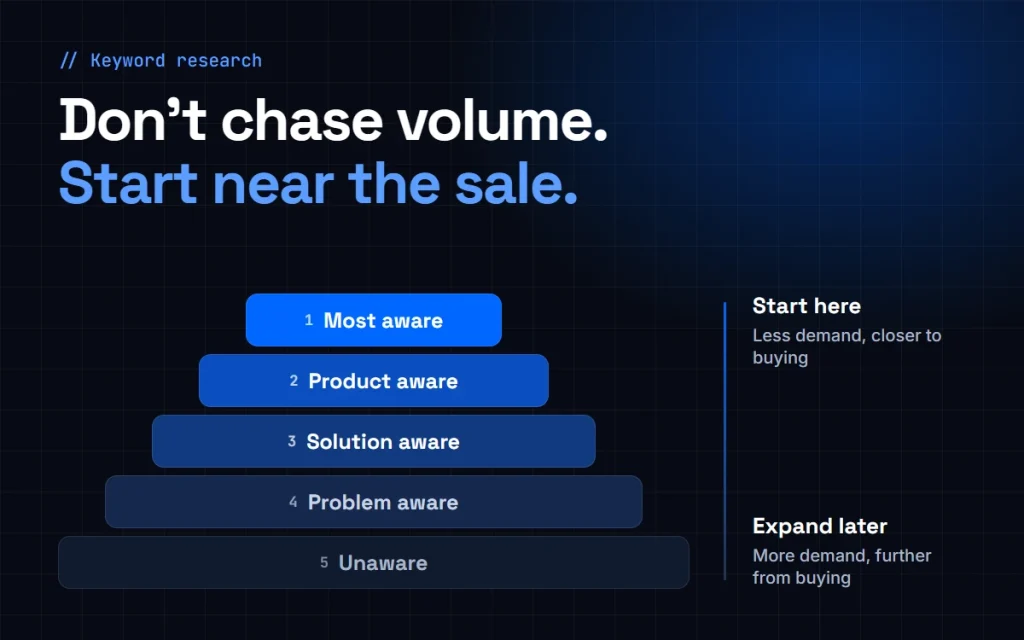
Gotch builds the strategy around the five stages of customer awareness. The advice is to start with the most aware searchers, who are closest to buying, then work outward to broader topics. Starting with broad, high-volume topics is the common mistake, because those searchers usually aren’t ready to buy.
The video uses SEO services and other industries as examples. To check my understanding, I wrote my own examples for a flower delivery shop in Cebu:
| Priority | Stage | Example search |
|---|---|---|
| 1 | Most aware | [shop name] discount code |
| 2 | Product aware | [shop name] reviews |
| 3 | Solution aware | best flower delivery in Cebu |
| 4 | Problem aware | how to send flowers last minute |
| 5 | Unaware | anniversary gift ideas |
Gotch sees the “best + solution” stage as especially important now, and suggests tracking those searches in both traditional results and AI answers.
What to Look at Instead of Volume Alone
- Demand: volume is only one signal. Others include Google Search Console impressions (with some caution, since not all are real people), discussions on Reddit and Quora, and questions from your own customers. Gotch suggests giving about 80% of your focus to topics with proven demand and keeping 20% for experiments.
- Cost per click: even if you don’t run ads, a high CPC suggests advertisers see commercial value in a topic. If nobody is advertising, Gotch treats that as a reason for caution, not a hidden opportunity.
- Organic click-through rate: AI Overviews, ads, People Also Ask and shopping results can all pull clicks away, so check the actual results page.
- Competition: look at the strength of competing domains and pages, the quality of their content, and now the brand as well. Gotch points out that AI answers can favor brands because of signals like reviews and consensus, even when they aren’t ranking especially well.
The Six-Step Process
- Create a template. Use one sheet as your source of truth, with columns for things like source, cluster, keyword, volume, difficulty, CPC, current position, intent, priority and status.
- Pick one category. Choose a single area you want to dominate, instead of researching everything at once.
- Find keyword ideas. Free sources include Google Search Console, Google Ads Keyword Planner, Reddit, People Also Ask, AI tools and your own company knowledge. Gotch starts with Search Console, especially for local campaigns.
- Filter the list. Combine the data points to narrow it down. In Gotch’s example, commercial intent and a good current position push a keyword up, while tough competition and a crowded results page pull it down.
- Analyze individual keywords. Look closely at the competitors and AI features you’d be up against.
- Prioritize for a sprint. Turn the list into a focused set of keywords you can actually finish in 30 to 90 days. Trying to target hundreds of keywords at once mostly creates paralysis.
Other Lessons Worth Remembering
- Go for low-hanging fruit first. Keywords already ranking in positions 2 to 15 get priority over brand-new targets, because improving those pages can bring big gains faster.
- Give each page one core topic. Put it in the URL, title tag, meta description, H1 and first sentence. Close variants can stay on the same page.
- Build a new page when the intent is more specific. If a broad page ranks poorly for a very specific search, that may be a sign the topic needs its own page.
- Don’t fear zero-volume keywords. Keyword tools lag behind new topics and often lack local data. A question people are really asking can still be worth covering.
- Only add a location when it changes the answer. A service’s price can vary by city, but the definition of a product doesn’t, so a city name there adds nothing.
- Treat AI as a first draft. It can generate ideas quickly, but you still need to edit them, refine the intent and decide what belongs on the list.
What I’m Taking from This
These are my own thoughts. The biggest change for me is the order of the work. It’s tempting to chase big volume numbers, but a smaller search from someone ready to buy may be worth more to a business. I also like the idea of working in sprints, because it gives a project a clear finish line.
For my own keyword research practice, I plan to start with a simple spreadsheet and free tools, then pick one small cluster and work through it fully. For a local business, like the one in my FlowerBarCebu case study, the awareness stages are a useful way to decide which pages to work on first.
One note if you watch the video: Gotch also promotes a paid template and Rankability, a tool from their own company. They say the process can be done with free tools, though it takes more time on larger projects.
You can watch the full video on YouTube. If you’d like help finding the right keywords for your business, get in touch.