
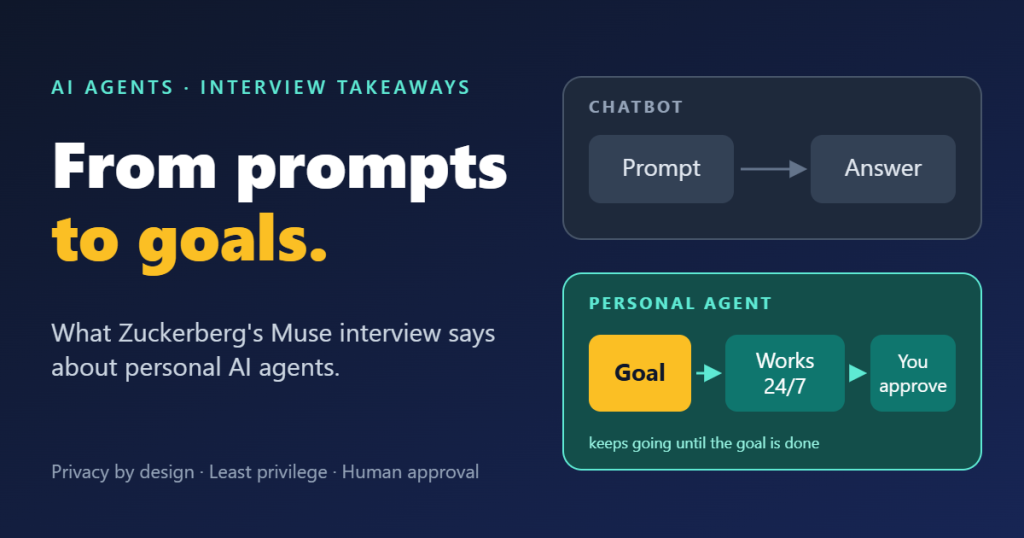
I recently watched Alex Heath’s interview with Mark Zuckerberg on the Sources podcast, titled “Mark Zuckerberg on how Meta’s Muse AI agent will make people money.” He talks about Meta’s long essay on its AI philosophy, the new Muse personal agent, how the company is trying to make agents safe, and a few other topics along the way.
Here’s what stood out to me as someone who builds websites and works with AI tools. The summary reflects what was said in the interview. Everything he says about Meta’s own products is his own account, and some of it describes products that haven’t fully launched yet. My own view is in the last section.
Meta’s Bet: Give the Technology to Everyone
Zuckerberg opens by explaining why Meta published a long essay (he mentions about 15 pages). His argument rests on three principles:
- Empowering people is the source of prosperity.
- AI’s main purpose will be inventing new things, not just automating existing ones.
- Safety comes from checks and balances and a balance of power, not from restricting access.
He says he disagrees with a common view in Silicon Valley that powerful AI should be restricted to a small number of people. He’s more worried about a few labs controlling something this capable. His cybersecurity example: if someone has an AI that can hack systems, the best defense is everyone having AI to harden their own systems first. He points to open-source software as a historical parallel.
He’s also clear that he isn’t a “zealot” about it. Meta releases some open models and keeps some work closed.
Data Centers and Local Communities
When asked why sentiment toward AI and data centers is so negative, he gives a more specific answer than I expected. He separates companies that commit to a community for decades from speculators who buy a plot of land and try to sell it to a bigger lab. He says the first group has strong reasons to make the project work for locals.
His examples: tax revenue in Louisiana that funded large bonuses for teachers, and a training program meant to produce the electricians, fiber technicians and other skilled trades that data centers need. He frames that program as self-interest rather than philanthropy, because Meta needs those people.
What Muse Actually Is
This was the most interesting part for me. Zuckerberg describes the difference between today’s chatbots and a personal agent:
- Chatbots: you send a prompt, you get an answer.
- Muse: you give it projects or goals, it has a virtual machine behind the scenes, and it keeps working on them around the clock.
His personal examples are everyday ones: setting up a weekend baking project for him and his three-year-old daughter (including ordering ingredients), watching for hiking permits to become available, and reviewing footage from cameras he set up at his MMA gym. He also says it suggests new projects. It helped make a strategy guide for a video game, then proposed expanding it into historical lessons.
On pricing, he says there will be a large amount of free usage, and he mentions 100 million tokens a week to start. For people running businesses with it, the expected model is a small cut of transactions, which he says would come from the businesses involved rather than the user.
How They Say They’re Handling Privacy and Security
Zuckerberg says privacy and security will be a major differentiator, and he lists several design choices:
- Confidential VM: the goal is that Meta can’t see what’s inside your agent’s environment, and he says this can be technically verified. He says more details will be published in the coming weeks.
- Secure credential store: the agent shouldn’t know your card numbers or passwords. It gets access only when you’ve asked it to log in somewhere.
- Sentinel agents: separate agents that monitor incoming and outgoing data, look for prompt injection, and trigger a human review.
- Human approval: logins, payments and transfers of sensitive information need your approval, though you can allow certain kinds of actions in general.
- Least privilege: connecting your email starts read-only, and sending is something you enable separately.
Quick Notes on Other Topics
- Models: he mentions Muse Spark 1.3 as the latest release and a bigger model, code-named Watermelon, shipping soon. He says Meta is not content to stay just behind the frontier.
- Government: he favors a close, ongoing partnership over a rigid framework, because the challenges change so quickly.
- Glasses: he acknowledges that Meta needs to communicate more clearly about the recording light and anti-tampering measures now that the glasses are mainstream.
- Teen safety: he describes a settlement framework where Meta takes the first step and hopes other platforms sign on to the same terms.
What I’m Taking From This
These are my own conclusions, not Zuckerberg’s.
- The shift from prompts to goals is the real story. Whichever company you follow, the direction is the same: AI that you assign work to, rather than AI you ask questions. That changes how I think about the tools I use every day.
- Permission design is a good checklist for anyone using agents. Start read-only, add access only when needed, and keep a human approving payments and logins. I can apply that to my own setups with AI tools today, whether or not I use Muse.
- If agents act for people, websites may be used differently. The interview talks about agents ordering ingredients and handling transactions. If more people send an agent to do research and buy things for them, the basics of a good website still matter: clear information, working pages, trustworthy details. I’m still early in my SEO career, and I can’t say how this will play out. It’s something I’m watching.
- Treat the claims with some caution. This is a company’s CEO describing its own products. The security claims in particular will matter most once the technical details are published and independently reviewed.
The full conversation is worth a listen if you follow AI agents: watch the episode on YouTube.